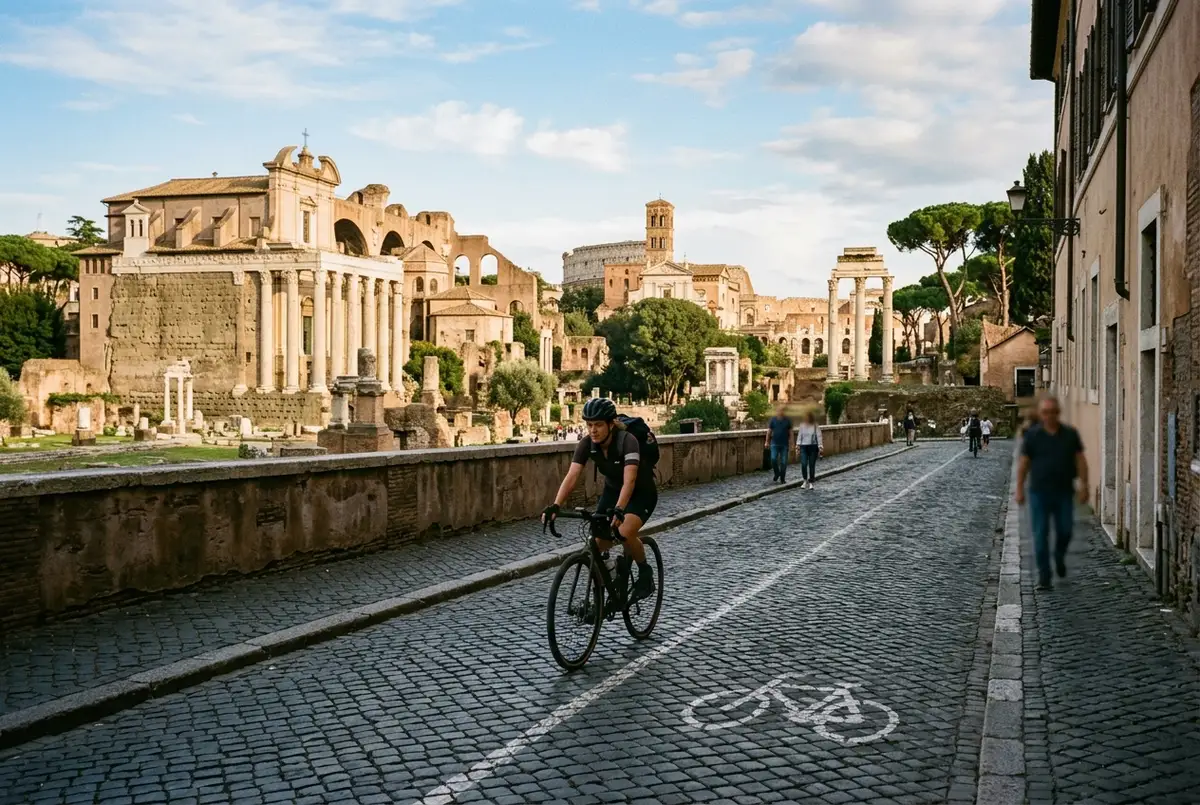
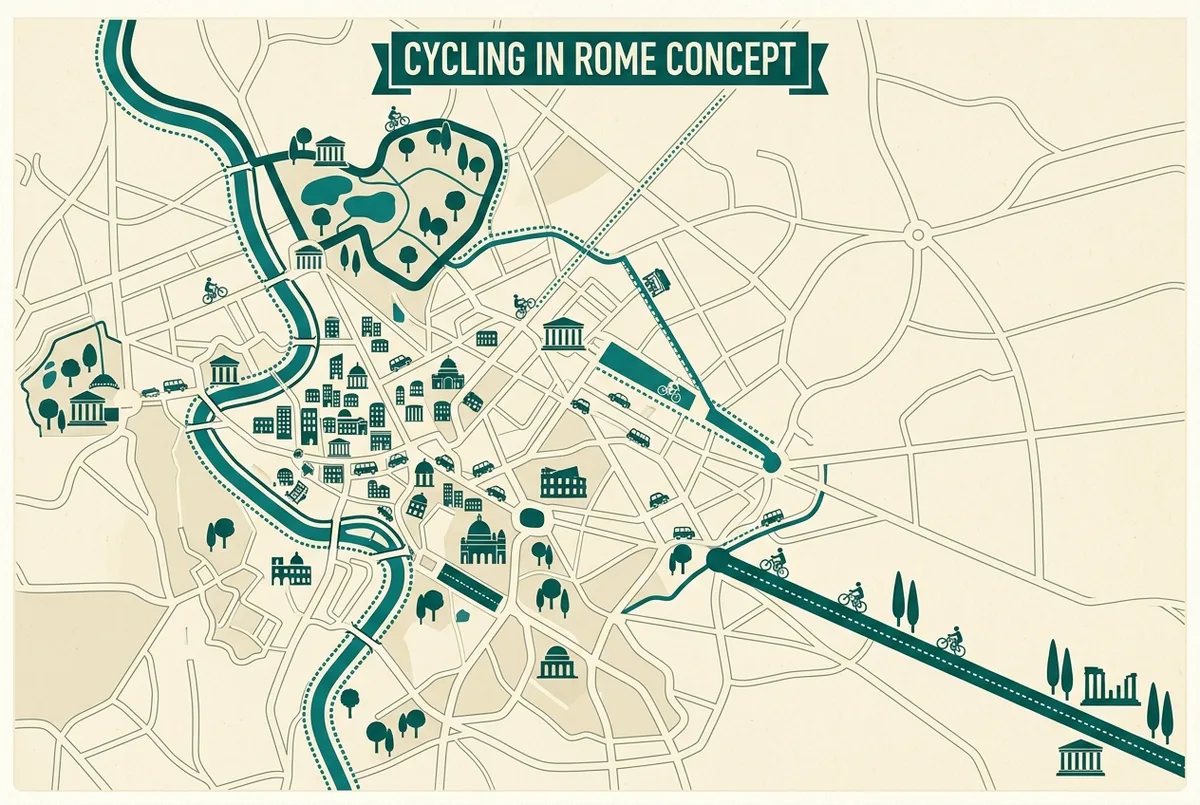
Cycling in Rome means something different than cycling in Amsterdam or Copenhagen, and setting that expectation early saves you a rough first afternoon. Here’s the honest starting point: Rome’s historic center mixes real traffic, cobblestones and hills with genuinely excellent stretches, like the Appian Way and the riverside path, so the city rewards cyclists who pick their route deliberately rather than wing it.
I’ll cover what actually surprises first-time visitors about riding here, the traffic, the terrain and the heat, then point you toward the specific decision you actually need to make: whether it’s safe enough to ride solo, where to rent, or whether to join a guided tour instead. Since price, group size, duration and what’s included are exactly the details that separate one option from another once you’ve decided to book a ride, it’s worth seeing how every Rome bike tour on this site stacks up on price, duration and route before you pick a specific one.
Is Rome a Good City for Cycling?
Mixed, honestly, and I’d rather tell you that upfront than oversell it. Rome wasn’t built with cyclists in mind the way Amsterdam or Copenhagen was, so you won’t find a city-wide network of protected lanes. What you will find are specific pockets, Villa Borghese, the riverside Lungotevere path, and the Appian Way regional park, that genuinely rival any European cycling city, alongside a historic center that’s better tackled with local knowledge than a solo first attempt.
My honest read: don’t expect the city as a whole to be effortlessly bike-friendly, but don’t write it off either. The good stretches are good enough to build a full day around.
Check prices & dates
Ready to visit?
Book your tickets in advance: popular time slots sell out.
What Makes Rome’s Traffic Different From Northern European Cities?
Scooters, mainly, and drivers who treat lane markings as more of a suggestion than a rule. Rome’s traffic moves fast and close, especially around major intersections and roundabouts, in a way that catches visitors from countries with stricter lane discipline off guard. Bike lanes exist but they’re inconsistent, sometimes disappearing mid-block or sharing space with parked cars.
I wouldn’t call this dangerous exactly, but I would call it a genuine adjustment. My full breakdown of whether Rome is actually safe for cycling covers the specific rules, lane situation and where I’d steer a nervous first-time rider instead.
Are Cobblestones a Real Problem for Cyclists in Rome?
Yes, on some streets, though it’s more of an annoyance than a hazard once you know to expect it. The sampietrini stones common in the historic center are uneven and can be slippery when wet, and they’re genuinely rougher on a standard bike than an e-bike with better suspension and wider tires. Most guided routes plan around the worst stretches rather than riding straight through them.
I’d recommend closed-toe shoes and a firm grip through any cobbled section rather than assuming it rides like smooth pavement, since a moment of inattention on wet sampietrini is where most minor spills happen.
Is Rome Too Hilly to Cycle Comfortably?
Not uniformly, but there are real climbs, the Gianicolo and the approach to Villa Borghese being the two visitors notice most. The historic center itself is fairly flat, so a route that sticks close to the river and the main archaeological sites won’t test your legs much. It’s the detours up toward the better viewpoints that add real elevation.
My honest take: take the e-bike option if one’s offered, especially in summer heat. It costs the same on most listings here and removes the one part of cycling in Rome that actually wears people out.
Is Rome Safe for Cycling Overall?
It’s manageable, especially away from the busiest intersections, but I wouldn’t call it effortless for a first-time visitor riding solo. Central Rome’s bike-lane network is patchy, and the historic center puts cyclists close to both pedestrians and vehicles at once. My full safety breakdown goes deeper into specific streets, rules and where a guide genuinely earns their fee.
What’s the Best Way to Start Cycling in Rome as a First-Time Visitor?
I’d start with a guided ride rather than a solo rental, plainly. A local guide already knows which streets to avoid, which intersections need extra caution, and how to string together a route that avoids the worst traffic while still hitting the major sights. Once you’ve absorbed some of that local knowledge on a first ride, a solo rental on a later day or a later trip becomes a much easier call.
Should You Rent a Bike Solo or Join a Guided Tour?
This is the biggest practical fork for most visitors, and I think it deserves more weight than people give it. A guided tour costs more but removes navigation and traffic judgment entirely, while a solo rental costs less and gives you total freedom over pace and route, at the price of figuring out Rome’s traffic yourself. My guide to renting a bike in Rome covers pricing, requirements and where to rent if you’re leaning solo, and my Appian Way bike tour guide covers the guided option in detail if you’d rather have a local handle the route entirely.
I’d genuinely recommend the guided route for a first Rome visit, and I don’t think that’s just me being cautious, it’s a real time and stress saving on a trip where your days are already limited.
Which Areas of Rome Are Actually Good for Independent Cycling?
Villa Borghese’s internal paths, the Lungotevere riverside route, and the Appian Way regional park stand out clearly. All three keep you largely away from car traffic while still delivering genuinely scenic riding, ancient pines and Roman aqueducts on the Appian Way, sweeping park paths in Villa Borghese, and a straightforward riverside line if you just want to cover distance without navigating turns.
I’d steer a confident solo cyclist toward these three areas specifically and away from the narrow, congested streets of the centro storico, which I think are better covered on foot or with a guide who knows the shortcuts.
Does the Season Change How Enjoyable Cycling in Rome Is?
Considerably. Spring and autumn offer the most comfortable temperatures for a multi-hour ride, while a midday July or August ride risks real heat exhaustion without an early or evening slot. Winter is workable but daylight hours run shorter, which narrows your window for an afternoon ride.
My honest advice: if your trip dates are flexible at all, shoulder-season months make cycling here noticeably more pleasant than the peak of summer.
Is the Appian Way a Good First Ride for a Visitor?
I think it’s one of the best options for exactly that, actually, more than a city-highlights loop for a nervous first-time cyclist. A large share of the route runs off-road through parkland, well away from Rome’s chaotic city traffic, and it’s genuinely one of the most scenic rides in the entire region. My full Appian Way bike tour guide covers the route, what you’ll see and the two real ways to ride it, guided or self-guided.
What Should You Wear and Bring When Cycling in Rome?
Closed-toe shoes are worth prioritizing over sandals, even in summer heat, since pedal grip matters more than comfort on cobbled sections. I’d also bring sunscreen and a refillable water bottle regardless of season, since Rome’s sun is stronger than visitors from cooler climates often expect, even outside the height of summer. A light jacket earns its space in a bag for an early morning or evening ride, when temperatures drop more than the daytime forecast suggests.
Is Cycling a Good Way to See Rome With Kids?
Yes, with the right setup, and I’d say it’s genuinely one of the more engaging ways to keep young kids interested in a full day of sightseeing. Child seats, tag-along extensions and age-appropriate e-bikes are available on several guided products, and the movement itself tends to hold a child’s attention better than a slow walking itinerary does. My family bike tour guide covers the specific age rules worth checking before you book.
How Does Cycling Compare to Renting a Scooter in Rome?
A scooter moves faster and handles Rome’s hills without effort, but it requires a license in most cases, leaves you hunting for parking, and puts you in the thick of the same aggressive traffic on a heavier, faster machine. A bike, by contrast, needs no license, costs less to rent, and is legal on more pedestrian-friendly streets and paths than a scooter ever will be.
I’d pick a bike over a scooter for nearly any first-time visitor, honestly. The speed advantage a scooter offers matters less than the added stress of navigating Roman traffic on something you’re less practiced with, and a guided e-bike closes most of the effort gap anyway.
Is Public Transport a Better Option Than Cycling for Some Trips?
For certain point-to-point trips, yes, and I wouldn’t force cycling into every part of your itinerary. Rome’s metro and bus network is genuinely useful for covering longer distances quickly, especially between neighborhoods that don’t sit on an obvious cycling route, or on a day when heat or rain makes riding unappealing. I’d treat cycling as the better choice specifically for sightseeing loops and scenic routes, and public transport as the better choice for simple transfers between two fixed points.
My honest take: the two aren’t really competing, most visitors end up using both across a single trip, a bike tour for the experience and the metro for practical transfers on other days.
What Do First-Time Visitors Get Wrong About Cycling in Rome?
The single biggest mistake I see is assuming the whole city rides like a flat, orderly European capital because the historic center looks compact on a map. Visitors who rent a bike without checking a route in advance often end up on a genuinely stressful street they could have avoided entirely with a bit of planning or a guide. The second most common mistake is underestimating the heat, riding a full afternoon loop in August without an e-bike option or an early start.
I’d tell any first-time visitor to treat route planning as seriously as they’d treat it in any unfamiliar city, not as an afterthought once you’ve already got the bike in hand.
Is Cycling in Rome Expensive?
Not particularly, compared to other ways of seeing the city. A standard bike rental runs roughly EUR 10 to 20 a day, an e-bike EUR 25 to 40, and a guided half-day tour EUR 45 to 67 per person with the bike, guide and helmet all bundled into that single fare. Set against a full day of paid museum entries or a private driver, cycling is one of the more affordable ways to cover serious ground in Rome.
I’d say the real cost consideration isn’t the euro amount, it’s deciding whether the extra fee for a guide is worth it to you over a bare rental, which is really a safety and convenience question dressed up as a budget one.
How Long Does It Actually Take to Feel Comfortable Cycling in Rome?
Faster than most visitors expect, in my honest experience thinking through how this usually goes. A single guided ride is often enough to absorb the basic traffic rhythm, where scooters tend to pass, which intersections need extra caution, and it genuinely changes how a second ride, solo or guided, feels afterward. I wouldn’t expect to feel fully at ease after five minutes on a bike here, but I also wouldn’t expect it to take days.
A multi-day trip that includes cycling on more than one day tends to build this comfort naturally, since each ride reinforces the last. That’s part of why I’d recommend a guided ride specifically on your first day if cycling is a bigger part of your itinerary than just one outing.
Is It Worth Combining a Bike Ride With Other Activities on the Same Day?
Usually, yes, and I’d plan around it rather than treat cycling as an isolated block of time. A morning bike ride pairs naturally with an afternoon spent on foot inside a museum or monument the route only rode past, since four hours of riding plus a slower indoor visit makes for a full but not exhausting day. I wouldn’t stack a bike tour with another physically demanding outdoor activity on the same day, though, since the combined fatigue tends to sour both experiences.
My honest suggestion: treat a bike ride as your one big physical activity for the day and build everything else around it at a gentler pace.
My Honest Recommendation
If you’re new to Rome and cycling here for the first time, I’d start with a guided ride, whether that’s a city-highlights loop or the Appian Way, rather than renting solo on day one. It removes the two genuinely tricky parts, traffic judgment and navigation, and lets you actually enjoy the ride instead of white-knuckling through an unfamiliar intersection. You can book straight into a Rome bike tour once you’ve decided which approach fits your trip. Once you’ve got a feel for the city, a solo rental along the riverside path or through Villa Borghese is a perfectly reasonable way to spend a quieter afternoon. Rome’s official tourism site, turismoroma.it, is a solid source for current park hours and seasonal closures while you plan. Whichever path you choose, I think cycling remains one of the most efficient and genuinely enjoyable ways to experience this city, uneven cobblestones and all.
Do You Need to Be an Experienced Cyclist to Enjoy Rome by Bike?
No, not really, and I wouldn’t want that assumption to talk anyone out of trying it. The pace on most guided routes is described as leisure level, meaning anyone who can comfortably ride a bike on flat ground keeps up without strain, and the e-bike option removes most of the physical demand that would otherwise favor a stronger rider. I’d say basic bike-handling comfort matters more than fitness or experience here.
The one skill that genuinely helps is staying calm and predictable around unfamiliar traffic, which is exactly the thing a guide takes off your plate on a first ride.
Frequently Asked Questions
Is cycling in Rome safe for tourists?
It’s manageable, especially away from the busiest intersections, but I’d recommend a guided ride or a quiet route like the Appian Way for a first-time visitor.
Is Rome a bike-friendly city?
Unevenly. Specific areas like Villa Borghese, the riverside path and the Appian Way are genuinely excellent, while the historic center’s narrow streets are trickier.
Do I need an e-bike to cycle comfortably in Rome?
Not strictly, but I’d recommend one if it costs the same as the standard option, since it removes real climbs like the approach to Villa Borghese.
Is the Appian Way a good place to start cycling in Rome?
Yes, in my honest opinion. A large share of the route runs off-road through parkland, away from the city’s more chaotic traffic.
Should a first-time visitor rent a bike or join a guided tour?
I’d lean guided for a first visit. It removes navigation and traffic judgment, the two hardest parts of cycling here for someone unfamiliar with the city.