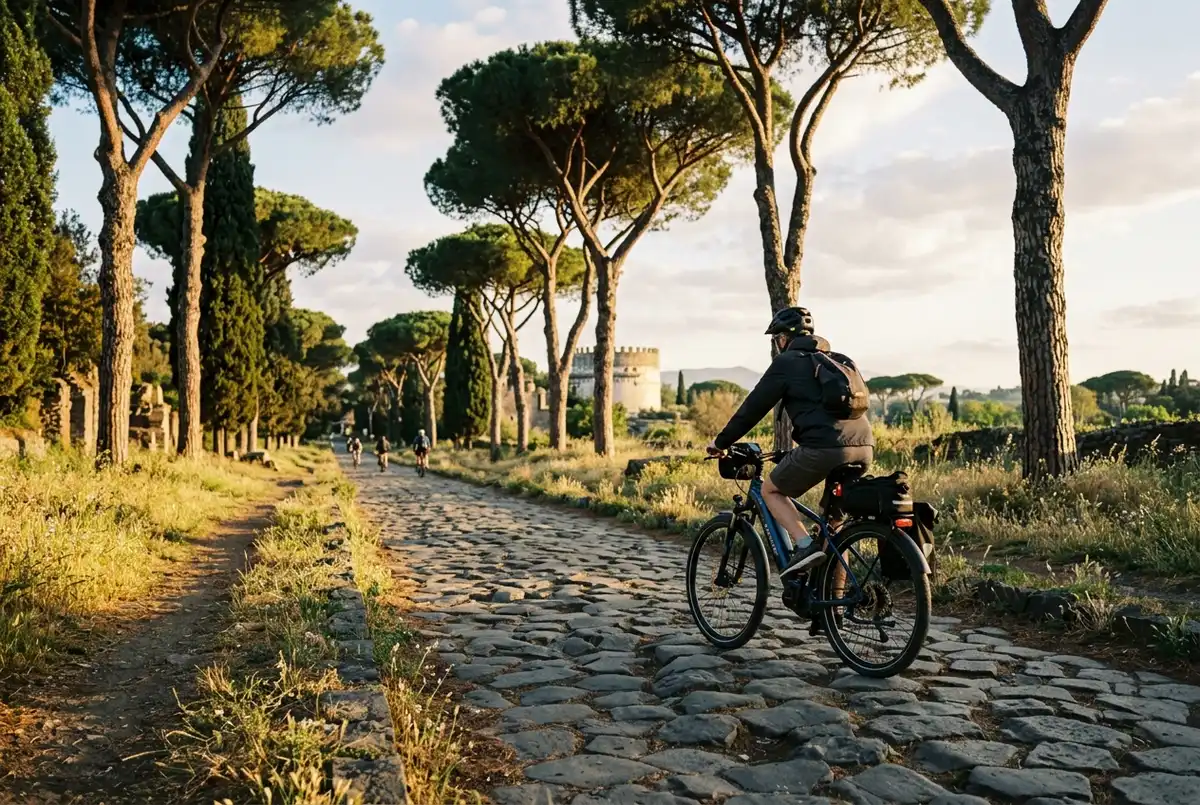
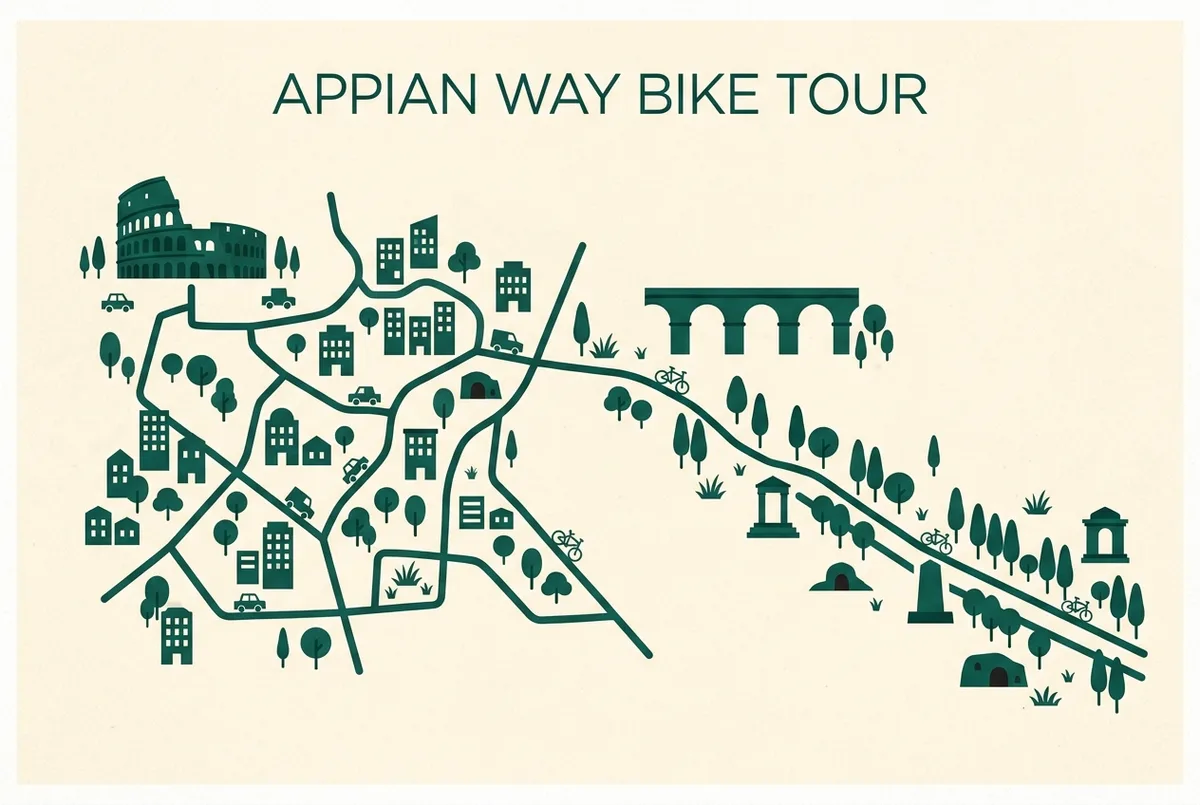
Appian Way bike tour routes cover Rome’s oldest strategic road, a flat, largely traffic-free stretch of original basalt paving lined with umbrella pines, ancient tombs and Roman aqueducts, and I’d call it the best bike route in the entire city without much hesitation. My honest take: if you’ve already done a Colosseum-and-Pantheon loop and want to see genuinely different Rome, this is where I’d send you next.
I’ll walk through exactly what makes this road worth riding, the two real ways to do it, joining a guided e-bike tour with a local or renting and riding it yourself, and which one I’d actually pick depending on your trip. Every price, distance and inclusion below traces back to what’s currently bookable, not a generic description of the road. Since price, route length and what’s included are exactly the attributes that separate one Appian Way product from another, it’s worth seeing how all six Rome bike tours on this site compare by distance and terrain before you settle on one.
What Makes the Appian Way Rome’s Best Bike Route?
Three things set it apart from every other cycling option in the city: it’s largely flat, a meaningful stretch closes to most car traffic on Sundays, and it runs through genuine countryside rather than crowded city streets. That combination is rare in a historic center built around narrow cobbled roads and constant scooter traffic.
I’d put it plainly: nowhere else in Rome gives you 2,300 years of history with this little traffic stress attached. The Colosseum-to-Pantheon loop is worth doing too, but it’s a city ride first and a history lesson second. The Appian Way flips that order.
Check prices & dates
Ready to visit?
Book your tickets in advance: popular time slots sell out.
The road itself still carries stretches of its original basalt paving, first laid in 312 BC, and riding it is one of the few ways to cover real distance along it without a car. Along the route you’ll pass the Circus of Maxentius, a remarkably intact ancient chariot-racing stadium, the cylindrical Tomb of Cecilia Metella, and the Parco degli Acquedotti, where multiple Roman aqueducts stretch across open grassland in a view that genuinely doesn’t look like anywhere else in the city.
My honest opinion: the Parco degli Acquedotti is the single best photo stop on any Rome bike tour, full stop. If you only remember one image from this ride, it’ll probably be that one. For the full rundown of every stop and what each one is actually worth your time, my catacombs and aqueducts route guide breaks the whole ride down section by section.
Is the Appian Way Closed to Cars on Sundays?
A long stretch of the historic road closes to most car traffic on Sundays, which noticeably calms the ride compared to a weekday ride sharing the same lanes with local traffic. It’s not a total closure everywhere along the route, so I wouldn’t treat it as a car-free guarantee, but it’s a genuine and reliable improvement.
I’d book a Sunday ride if your schedule allows it, it’s the single easiest way to make this route feel even calmer than it already is. My best time to ride guide covers this alongside the time-of-day question, since both timing decisions matter roughly equally.
What’s the History Behind This Road?
The Via Appia Antica was Rome’s first great strategic road, built to move troops and trade south toward Brindisi, and it’s lined with funerary monuments because Roman law barred burials inside the city walls. Riding it genuinely doubles as riding through the story of the Republic and early Empire, not just pedaling past scenery with old-sounding names attached.
I think this context changes how the ride feels. Knowing why the tombs are there, and why this road mattered more than almost any other in the ancient world, turns a pleasant countryside ride into something with real weight behind it. My Appian Way history guide goes deeper into this if the history is what drew you here in the first place.
Should You Join a Guided E-Bike Tour or Ride It Yourself?
This is the real decision, more than which specific product you book. A guided e-bike tour hands you a local who already knows which unmarked side roads lead to the catacombs and aqueducts, plus a bike with pedal assist built in for the distance. Riding it yourself gives you full control over pace and stops, but you’re navigating unfamiliar countryside roads with far weaker signage than the city center.
My honest recommendation for a first ride here: go guided. The Appian Way’s side roads genuinely aren’t well marked, and I’ve heard enough accounts of solo riders missing a turn and adding an unplanned hour to their day that I’d rather pay for a route someone else has already worked out. My self-guided rental guide covers exactly what riding it solo involves if you’d still rather go that route.
How Long Is the Full Appian Way Route?
A full loop covers roughly 27 kilometers on the featured product here, with about 60 percent running off-road through parkland and the rest connecting through city streets back to the meeting point near the Colosseum. That’s a genuine ride, not a stroll, and it’s noticeably more physical than a three or four-hour city loop even with an e-bike doing most of the climbing work.
I’d rate this route as intermediate rather than beginner-friendly given the distance alone. If that sounds like more than you want to take on, I’d point you toward a shorter city highlights loop instead and save the Appian Way for a day when you’re not also trying to fit in three other sights.
Do You Need an E-Bike for This Route?
I’d say yes, more than for most Rome routes. The distance alone justifies pedal assist for most visitors, and the mixed terrain, some smooth paved sections, some rougher original basalt, means the extra power genuinely helps on the uneven stretches, not just the climbs. A standard bike can manage it, but you’ll feel the full 27 kilometers by the end in a way an e-bike rider won’t.
My Appian Way e-bike guide breaks down exactly where the pedal assist matters most on this specific route, if you’re still deciding between the standard and e-bike versions of a guided tour.
Can You Visit the Catacombs on This Ride?
Some Appian Way products ride past the Catacombs of Rome without going inside; others build a guided underground visit directly into the itinerary. This is worth checking carefully before you book, since it’s the single biggest difference between otherwise similar-looking tours along this same road.
I’d book the version with catacombs access included if going underground matters to you, since arranging a separate ticket and transfer on another day is genuinely more hassle than paying a bit more for a single combined booking. My catacombs and aqueducts route guide covers exactly what that underground visit involves.
How Do You Get to the Appian Way From Central Rome?
Most riders start from a shop or pickup point closer to the historic center rather than cycling out to the park entrance through city traffic first, since that traffic adds real time and stress before the ride even begins. Guided tours typically build the ride out to the Appian Way into the route itself, starting from a central meeting point near the Colosseum.
I’d treat the getting-there logistics as a genuine reason to favor a guided option, since hotel-area pickup on some products removes this problem entirely. My getting to the Appian Way guide sets out the bus, metro and cycling options in full if you’re planning a self-guided day.
Is This Route Good for Families With Kids?
It can be, with some real caveats. Infants under one year generally can’t join, children roughly one to four ride free in a child seat, and kids five to eight typically use a tag-along extension. Given the distance, though, I’d think carefully before booking this specific route for a family day rather than a shorter, flatter city loop.
My honest read: the Appian Way’s length makes it a stronger second or third bike outing for a family already comfortable riding together, not a great first-day pick. A three or four-hour city highlights ride is the gentler starting point if you’re not sure how your kids will handle a longer distance.
What Should You Bring for This Ride?
Sunscreen matters more here than on a city loop, since the open countryside sections offer none of the shade you’d get riding through the historic center’s narrow streets. Comfortable closed-toe shoes and water are worth bringing regardless of which product you book, and I’d pack a light layer too, since the pace slows for photo stops and you’ll cool down quickly once you’re not pedaling.
I’d also bring a phone with some charge left specifically for photos at the Parco degli Acquedotti. It’s the kind of view that photographs better than you’d expect, and you don’t want to be down to five percent battery when you reach it.
How Does the Appian Way Compare to a City Highlights Bike Tour?
The two serve genuinely different purposes, and I wouldn’t treat them as competing options so much as complementary ones. A city highlights loop covers the Colosseum, Pantheon, Trevi Fountain and Piazza Navona in three to four hours, dense with landmarks and built for a first day in Rome. The Appian Way trades that landmark density for open countryside, ancient ruins with far fewer crowds, and a genuinely calmer pace.
My honest recommendation if you’re only doing one Rome bike tour: pick the city highlights loop for a first visit, since it covers more of what you came to Rome to see. If you’re staying longer or have already done that loop on a previous trip, the Appian Way is where I’d send you next. My best bike tours in Rome guide rounds up every style, city, countryside, night and sunrise, if you want the full lineup before deciding.
Is a Rental or a Rome Bike Rental Guide Worth Reading First?
If you’re leaning toward riding the Appian Way on your own rather than joining a guided group, I’d read up on the basics first, ID and deposit requirements, which shops actually stock bikes suited for a longer countryside ride, and what a full day of rental actually costs versus a guided flat rate. My Rome bike rental guide covers all of that in one place.
I think this is worth doing even if you end up choosing the guided option anyway. Understanding what a solo rental actually involves makes it a lot easier to judge whether the guided price is genuinely fair value for what it removes from your day.
My Honest Recommendation
If this is your first Rome bike ride, I’d start with a city highlights loop and save the Appian Way for a second outing once you’ve already got a feel for the city. If you’re already past that first ride, or you specifically want a calmer, history-dense countryside route, book a guided e-bike tour here rather than riding it solo, the unmarked side roads and the sheer distance are exactly the two things a local guide removes from your day. You can book a Rome bike tour directly once you’ve decided which route fits your trip. For up-to-date visitor information on the Appian Way Regional Park itself, turismoroma.it is a reliable official source worth checking before you go.
Frequently Asked Questions
Is the Appian Way good for a bike tour?
Yes, I’d call it Rome’s best bike route: flat, largely traffic-free on Sundays, and lined with genuine ancient history rather than crowded landmarks.
Do you need an e-bike to ride the Appian Way?
Not strictly, but I’d recommend one. The distance and mixed terrain make pedal assist genuinely worthwhile for most riders.
Can beginners ride the Appian Way bike route?
It’s rated intermediate mainly due to distance rather than technical difficulty. A confident beginner on an e-bike can manage it comfortably.
Is it better to book a guided Appian Way tour or rent a bike yourself?
For a first visit, I’d go guided. The unmarked side roads and navigation to the catacombs and aqueducts are the one real hassle a local guide removes.
How long does a full Appian Way bike tour take?
The featured 27-kilometer route runs about four hours, longer if you add optional stops like the catacombs or a food tasting on certain products.
Can children ride the Appian Way bike route?
Yes, with age-based options like a child seat or tag-along extension, though I’d treat this as a stronger second outing than a first-day family ride given the distance.