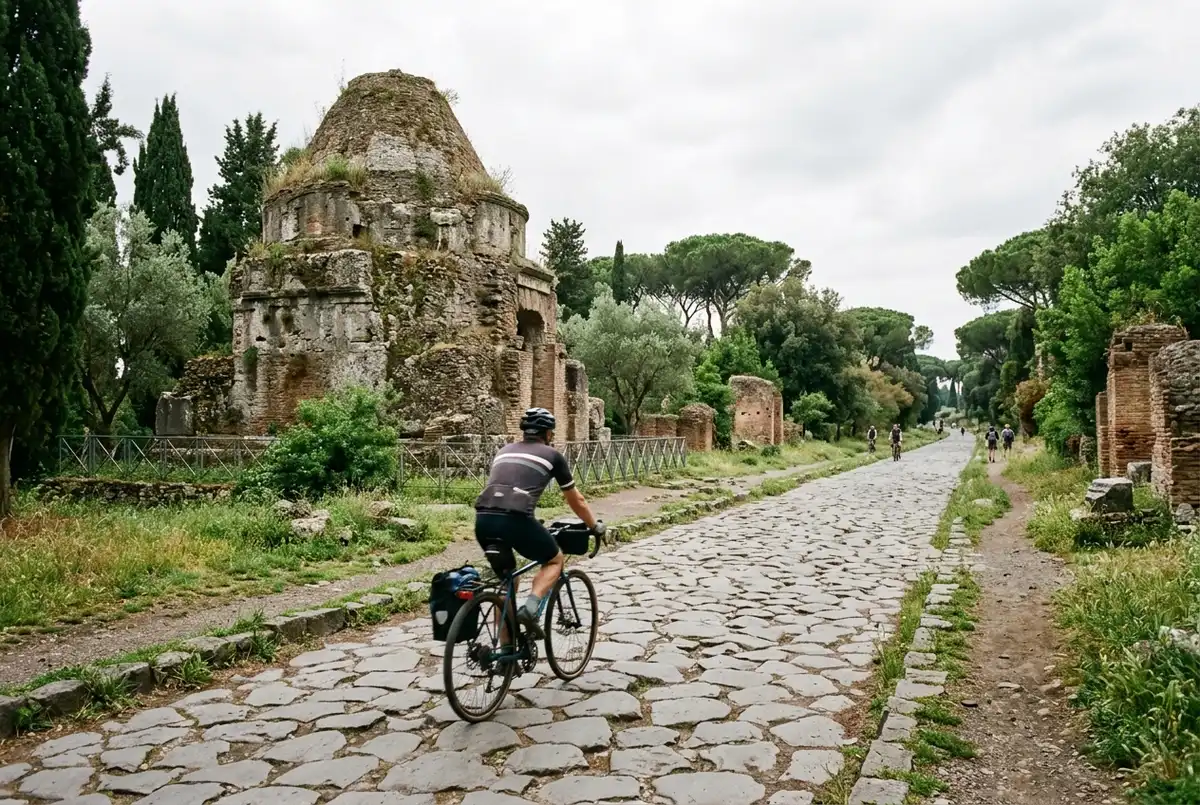
An ancient appian way bike tour covers ground that’s been in continuous use for over 2,300 years, since the Via Appia Antica was Rome’s first great strategic road, built in 312 BC to move troops and trade south toward Brindisi. My honest take: riding it is one of the few activities in Rome where the history isn’t a museum plaque next to the experience, it’s underneath your wheels.
I’ll walk through the road’s background, why it’s lined with ancient tombs, and how that context changes what you’re actually looking at along the route. For everything else about riding it today, my Appian Way bike tour guide covers the practical side, and you can look through Rome’s bike tour lineup if you’re comparing this route against others.
Why Was the Appian Way Built?
The Romans built the Via Appia Antica primarily as a military and trade route, connecting the capital to the southern Italian port of Brindisi and, from there, to routes across the Mediterranean. It was named for Appius Claudius Caecus, the Roman censor who initiated its construction, and it set the standard for the network of paved roads the empire would later build across three continents.
I think this military origin is worth holding onto as you ride. This wasn’t a scenic path built for leisure, it was infrastructure built to move legions quickly and reliably, which is part of why so much of the original paving has survived intact for two millennia.
Check prices & dates
Ready to visit?
Book your tickets in advance: popular time slots sell out.
Roman law barred burials inside the city walls, so wealthy and prominent Romans built elaborate funerary monuments along the major roads leading out of the city instead, and the Appian Way became one of the most prestigious addresses for the dead. That’s why a bike ride out here passes far more ancient tombs than temples or civic buildings.
My honest opinion: this detail changes how I’d frame the whole ride for a history-curious visitor. You’re not just cycling past old stones, you’re riding through what was effectively Rome’s most exclusive cemetery for centuries, one that early Christians later adopted for their own underground burial networks along the same road.
What Is the Tomb of Cecilia Metella?
The cylindrical Tomb of Cecilia Metella, built in the first century BC for a noblewoman from a prominent Roman family, is one of the best-preserved monuments along the entire route and marks roughly the midpoint of most bike routes today. Its scale alone tells you how much a single family was willing to spend to be remembered along this road.
I’d slow down here rather than treat it as a quick photo stop. Via appia antica history is easiest to grasp standing in front of a monument like this one, where the ambition behind it is still visible after two thousand years.
What Is the Circus of Maxentius?
The Circus of Maxentius, built in the early fourth century AD, was an ancient chariot-racing stadium and is remarkably intact for its age, with much of its original oval track and surrounding walls still visible. It sits directly on the route most riders take, usually early in the ride heading out from central Rome.
My honest take: this is the stop most first-time riders underestimate. It’s easy to expect a pile of scattered stones and instead find a structure whose shape and scale are still genuinely legible. My Appian Way bike tour guide covers exactly where this fits into a typical route.
Does the Original Road Surface Still Exist?
Yes, in stretches. Sections of the road still carry their original basalt paving stones, laid during the Roman period and still holding up to foot and bicycle traffic today, though the surface is noticeably rougher than a modern paved path. Riding over it is one of the few ways to physically experience infrastructure this old rather than just look at it.
I think this is the detail that makes an ancient rome bike tour along this road different from any museum visit. You’re not viewing the history behind glass, you’re rolling over it. My self-guided rental guide covers how rough those original sections actually feel to ride if you’re weighing a standard bike against an e-bike.
How Does the Aqueduct System Fit Into This History?
The Roman aqueducts visible at Parco degli Acquedotti, further along most bike routes, represent a different but related achievement: the engineering that let Rome grow into a city of over a million people by piping fresh water in from sources many kilometers away. They’re not part of the original Appian Way itself, but they sit close enough to the route that most tours combine both in a single ride.
My honest opinion: seeing the road and the aqueducts in the same afternoon gives you a fuller picture of Roman engineering than either one alone. My rome aqueduct bike tour guide covers what that combined stop actually looks like today.
Why Does This History Matter for Choosing a Route?
Because it explains why the Appian Way is worth a dedicated afternoon rather than a quick pass-through on the way to somewhere else. A road built to move an empire’s legions, lined with tombs from its most prominent citizens and later adopted by early Christians for their own burial networks, is carrying more layered history than almost any other single stretch of pavement in the world.
I’d factor this into how much time you budget for the ride. Rushing through 2,300 years of history to fit in one more sight afterward undersells what’s actually here. My best time to ride guide can help you plan a start time that leaves room to actually take it in.
What Happened to the Appian Way After the Roman Empire?
The road remained in use through the medieval period and beyond, though sections fell into disrepair as Rome’s population shrank and the empire’s administrative reach collapsed. Centuries later, the road and its surrounding monuments became a fixture of the Grand Tour, the traditional European journey wealthy travelers made partly to see exactly this kind of ancient ruin firsthand.
I think that continuity is part of what makes riding it today feel different from visiting a fenced-off archaeological site. This has been a route people have walked, ridden, and traveled for over two thousand years without a real break, which is a rarer thing than it sounds even in a city as old as Rome.
Why Is the Appian Way Protected as a Regional Park Today?
The Appian Way Regional Park exists specifically to protect this stretch of road and its surrounding countryside from the kind of development that’s swallowed up other ancient routes closer to the modern city center. That protection is exactly why the open, green character of the ride still exists at all, rather than being lined with modern buildings the way most other Roman roads eventually were.
My honest take: this protected status is worth appreciating as you ride, not just as a planning detail. The calm, traffic-light feel of the route isn’t an accident, it’s the direct result of a deliberate decision to keep this corridor open rather than let it develop like the rest of the city around it.
Is the History Interesting Even If You’re Not a History Buff?
I’d say yes, honestly. You don’t need to arrive with any background knowledge for the scale of what’s here to land, a road this old, tombs built for people who died two thousand years ago, a stadium where chariot races once drew crowds. The context deepens the experience, but it isn’t a prerequisite for enjoying the ride.
My honest opinion: even a casual visitor who just likes the idea of an open, green ride away from city traffic will come away with more than they expected once they see the scale of the Circus of Maxentius or stand next to the Tomb of Cecilia Metella. The history adds a layer on top of a good ride, it doesn’t gatekeep it.
My Honest Recommendation
If history is even part of why you’re considering this ride, don’t treat it as just another bike route, budget the time to actually stop at the tombs and the Circus of Maxentius rather than pedaling straight through. I’d book a guided version for a first ride here specifically so a knowledgeable guide can fill in this context as you go, rather than riding past monuments without knowing what you’re looking at. You can book a guided Appian Way tour directly from here, and my getting to the Appian Way guide covers the practical side of reaching the start point if you’re planning the logistics yourself. For deeper background on the road’s history, Wikipedia’s entry on the Appian Way is a solid, well-sourced starting point.
Frequently Asked Questions
When was the Appian Way built?
Construction began in 312 BC under Appius Claudius Caecus, making it Rome’s first great strategic road and one of the oldest paved roads in the world.
Why are there so many tombs along the route?
Roman law barred burials inside the city walls, so prominent Romans built funerary monuments along major roads leading out of the city instead.
What is the Tomb of Cecilia Metella?
A well-preserved first-century BC cylindrical tomb built for a noblewoman, marking roughly the midpoint of most Appian Way bike routes today.
Does the original Roman road surface still exist?
Yes, in stretches. Sections still carry original basalt paving stones that riders can cycle over today, though the surface is rougher than modern paving.
How does the Circus of Maxentius fit into the route?
It’s an early fourth-century chariot-racing stadium along the route, remarkably intact and usually one of the first major stops on a ride out from central Rome.