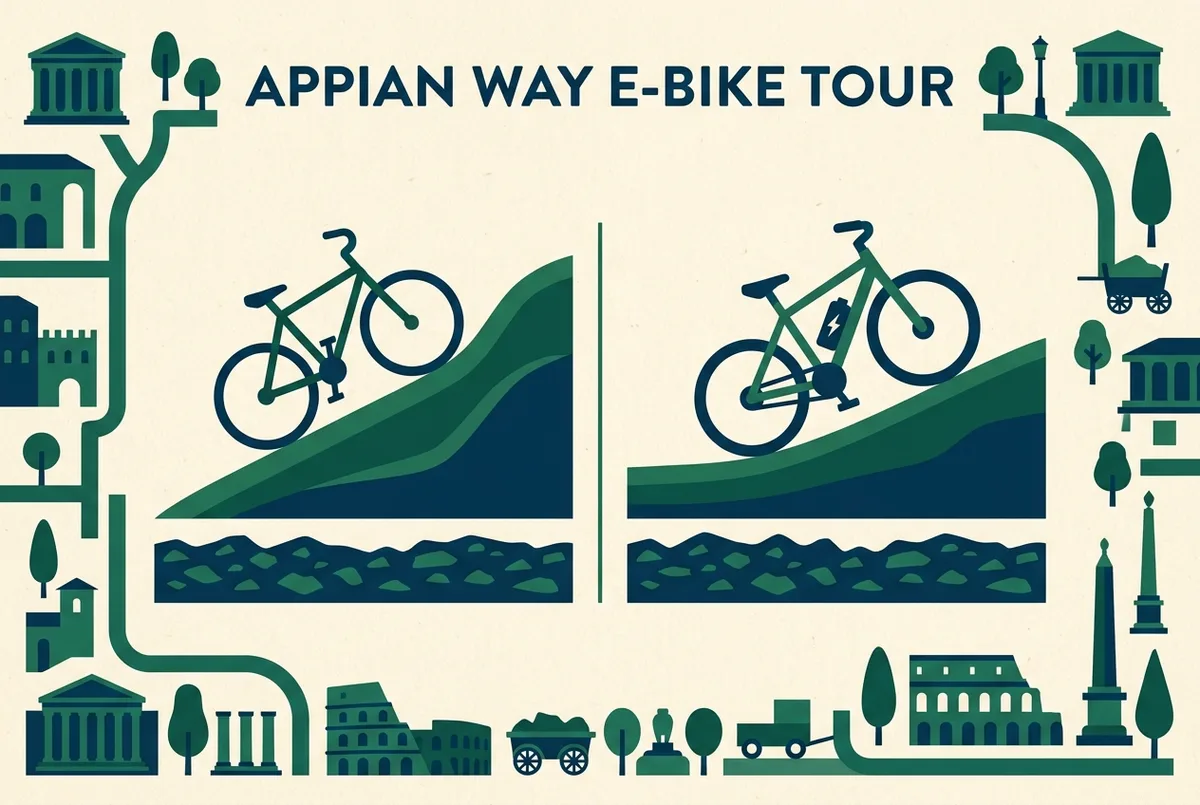
An appian way e bike tour is worth the extra cost for most riders, and my honest take is that this route makes a stronger case for pedal assist than almost anywhere else in Rome. It isn’t just about covering 27 kilometers, it’s the specific mix of a steady climb back into the city and long stretches of uneven original paving that make the standard-bike version noticeably more tiring.
I’ll break down exactly where the e-bike earns its keep on this specific route, and where a standard bike still gets the job done fine, so you can decide whether the upgrade is worth paying for on your trip. For the full picture on the whole route, my Appian Way bike tour guide covers everything from what you’ll see to how long it takes, and you can compare every Rome bike tour on this site if you’re weighing more than one option.
Where Does the Pedal Assist Actually Matter on This Route?
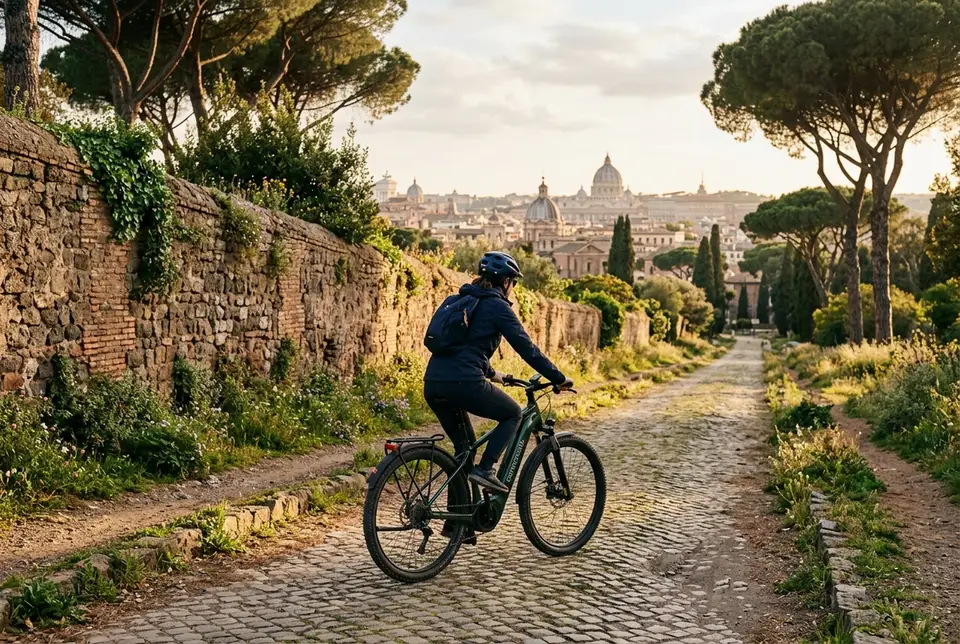
Two specific stretches, more than the ride as a whole. The gentle but steady climb back toward central Rome at the end of the loop is the one most riders feel first, since it comes after you’ve already covered most of the distance and your legs are tired. The second is the uneven basalt paving that survives in sections of the original road, where the extra power helps you keep a steady line rather than fighting the bike over every bump.
I’d say the flat, smooth stretches through Parco degli Acquedotti barely need the motor at all. It’s specifically the climb and the rough paving where an e-bike changes the experience, not the ride in general.
Check prices & dates
Ready to visit?
Book your tickets in advance: popular time slots sell out.
Noticeably, once you’re past the halfway point. The 27-kilometer distance alone puts real strain on riders who aren’t cycling regularly back home, and doing it on a standard bike means carrying that full effort through the climb back to the city without any help. It’s genuinely doable, plenty of confident cyclists prefer it, but I wouldn’t call it the easier option.
My honest read: a standard bike suits someone who cycles often and wants the workout as part of the day. For most visitors on a single Rome trip, that’s a smaller slice of the audience than people assume. My self-guided rental guide covers what riding this route on a standard rental actually involves if you’re leaning that direction anyway.
What’s the Price Difference Between Standard and E-Bike Options?
E-bike products on this route generally run a bit higher than a standard-bike equivalent, reflecting the cost of the bike itself and its battery, though the gap is usually smaller than you’d expect for what it removes from the ride. Check current pricing at booking, since it shifts with season and operator, but I wouldn’t treat the e-bike upgrade as a major budget decision either way.
I’d pay the difference without much hesitation on this specific route. E bike tour rome appian way products are priced close enough to the standard option that the comfort gain is worth more than what you’d save going without it.
Does the E-Bike Change What You Can See?
Not directly, the stops along the route, the Circus of Maxentius, the Tomb of Cecilia Metella, the catacombs entrance and the aqueducts at Parco degli Acquedotti, are the same regardless of which bike you’re on. What changes is how fresh you feel when you get there and how much energy you have left for the final stretch of the ride.
I think this matters more than it sounds. Arriving at Parco degli Acquedotti, the visual highlight of the whole route, on tired legs after a standard-bike climb is a genuinely different experience than arriving with energy still in reserve. My catacombs and aqueducts route guide covers exactly what you’ll see at each stop either way.
Who Should Skip the E-Bike Upgrade?
Confident, regular cyclists who want the physical challenge as part of the day, and anyone genuinely comfortable riding 27 kilometers with some climbing on a standard frame. If that describes you, I wouldn’t push the upgrade, the standard bike does the job and saves a bit of money.
My honest advice for everyone else, including most casual visitors on a single Rome trip: take the e-bike. This isn’t a route where I’d call the upgrade a nice-to-have. My best time to ride guide is worth pairing with this decision too, since a cooler morning start makes either bike option more comfortable.
Is the E-Bike Harder to Handle on the Rough Basalt Sections?
No, if anything it’s easier. The extra weight of the battery and motor adds a bit of stability on uneven surfaces, and the pedal assist means you’re not fighting momentum loss every time the front wheel hits a rough patch. Riders who are nervous about the basalt paving specifically tend to find the e-bike the more forgiving option, not the trickier one.
I’d only flag one thing: keep both hands firmly on the bars through the roughest stretches regardless of which bike you’re on, since a distracted moment on uneven basalt is where most minor spills happen. My Appian Way history guide explains why this particular stretch of paving has survived since antiquity, if you’re curious why it’s rougher than a modern road.
Does the E-Bike Cover the Full 27-Kilometer Route Reliably?
Yes, the battery range on these products is built around the full route length with margin to spare, so running out of charge partway through isn’t a realistic concern on a single loop. Guides also manage the pace and any stops, which keeps power use predictable rather than draining the battery on unnecessary detours.
I wouldn’t worry about range at all here. It’s one of the few genuine advantages of joining a guided appian way electric bike tour over a solo rental, since the route and pacing are already optimized around the bike’s capability.
Is the E-Bike Worth It If This Is Your Only Bike Day in Rome?
Yes, and I’d argue it matters more in this specific case. If the Appian Way is the one bike tour you’re fitting into a busy Rome itinerary, arriving fresh at the aqueducts and leaving with energy for whatever you’ve got planned that evening is worth more than the small amount you’d save on a standard bike. A tired, sore afternoon has a way of eating into the rest of your day in a way that’s easy to underestimate while you’re still planning the trip.
My honest take: this calculation shifts if you’re staying in Rome long enough to treat the ride as a proper training day or a deliberate physical challenge. For a single-day visitor squeezing this route between other sights, though, I wouldn’t overthink it. Take the e-bike and save your legs for walking the rest of Rome afterward.
Does the E-Bike Make the Route More Suitable for Less Frequent Cyclists?
Considerably. Someone who cycles occasionally, rather than as a regular habit, is exactly the rider who benefits most from pedal assist on a route this long. The gap between a confident regular cyclist and an occasional rider narrows a lot once the motor is doing a meaningful share of the work, which is part of why I’d recommend the e-bike option to a wider range of visitors here than I would on a shorter, flatter city loop.
I’d still flag one thing honestly: an e-bike doesn’t replace basic bike-handling comfort. If you’re genuinely nervous on two wheels in general, that’s a separate issue pedal assist doesn’t solve, and I’d think carefully about whether this route is the right choice regardless of which bike you pick. If you want a general sense of what pedal assist feels like before committing to the Appian Way’s distance, my electric bike tour of Rome guide covers the shorter, flatter city-loop version.
My Honest Recommendation
For most visitors, I’d book the e-bike version without much debate, the climb back into the city and the rough basalt stretches are exactly the two things pedal assist handles best, and this route has more of both than a typical city loop. If you’re a regular cyclist who wants the physical challenge, the standard bike is a reasonable choice too, just go in knowing you’ll feel the last few kilometers. For current visitor information on the Appian Way itself, turismoroma.it is a reliable official source worth checking before you book.
Frequently Asked Questions
Is an e-bike worth it for the Appian Way?
Yes, for most riders. The climb back into the city and the rough basalt sections are exactly where pedal assist helps most on this route.
How much more does an e-bike tour cost than a standard bike tour?
The gap is usually modest and varies by operator and season, so I’d check current pricing at booking rather than assume a fixed difference.
Can a standard bike handle the full Appian Way route?
Yes, plenty of confident cyclists do it, but the 27-kilometer distance plus the climb back means you’ll feel it more than on an e-bike.
Does the e-bike change what you see on the route?
No, the stops are the same either way. The e-bike changes how much energy you have left, not the itinerary.
Is the e-bike harder to handle on rough basalt paving?
No, if anything it’s steadier, since the extra weight and pedal assist help maintain a straight line over uneven surfaces.